














Most perimeter security buyers ask the wrong question first. They ask which detection technology is best. The better question is which detection technology fits the site, the threat, and the way the operator actually runs the system. Pick the wrong category and the install will fight you every day, regardless of the brand on the box.
This article walks through the four detection technologies most commonly specified for medium and high-security perimeters, what each is genuinely good at, and where each falls down. It is meant for integrators, consulting engineers, and end users who have to specify or approve a system and want to read past the marketing.
Fence-mounted sensors: the workhorse where you already have a fence
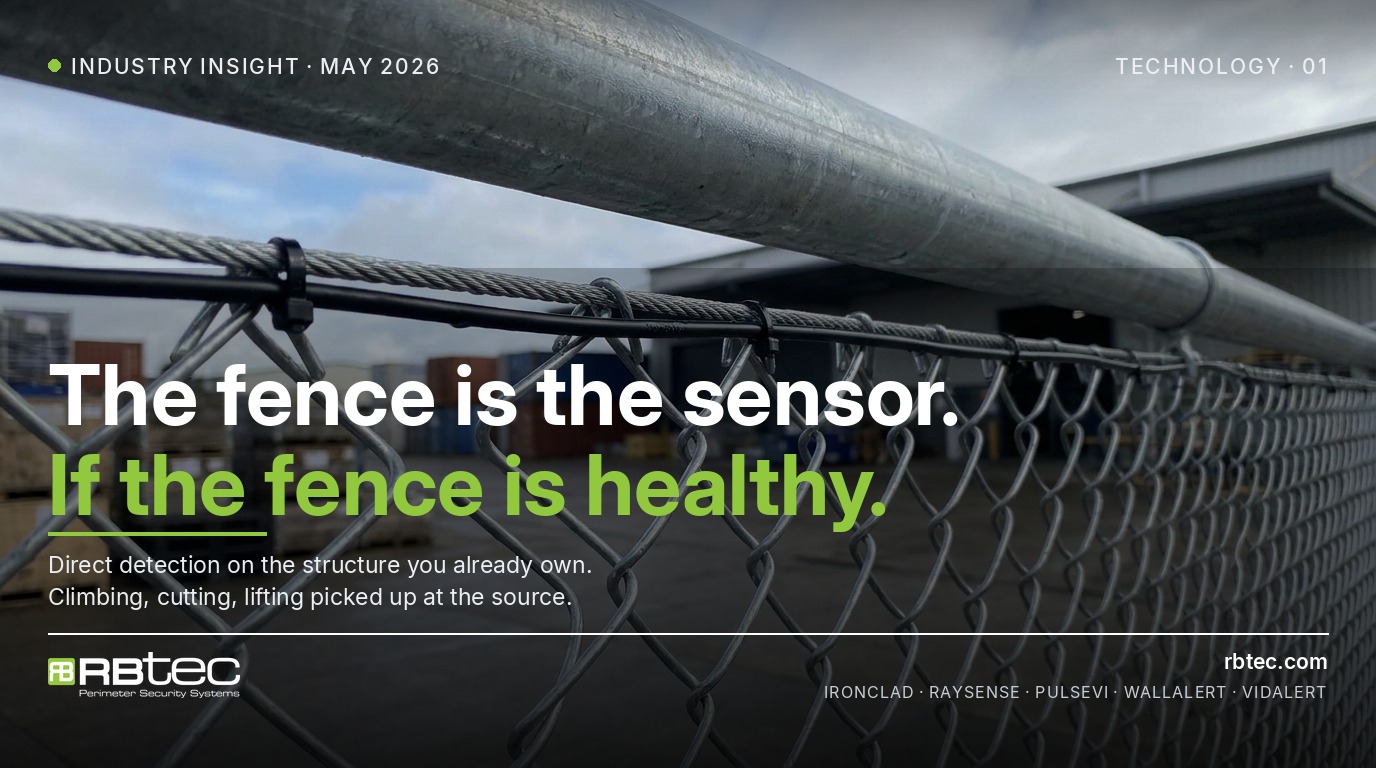
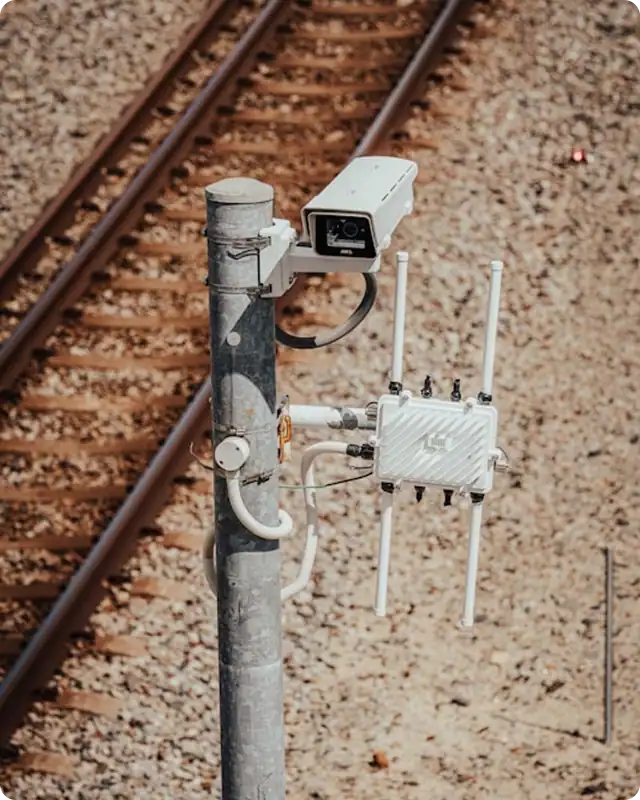
A fence-mounted sensor lives on the existing fence fabric and detects climbing, cutting, or lifting. The sensor reacts to the mechanical energy of an attack on the fence itself. Modern systems use accelerometers, piezoelectric elements, or microphonic cable, and feed the signal into a processor that classifies the event.
What fence-mount does well: it is the most direct way to detect an intruder attacking a fence, because the sensor is on the thing being attacked. It is also the most economical category per linear foot in a typical site. It works on chainlink, welded mesh, palisade, and many ornamental fences. Installation is non-trenching, which matters when timelines are tight.
Where fence-mount struggles: a fence that is in poor condition is a noisy fence. Loose fabric, broken ties, missing tension wire, and worn fittings produce signals the sensor cannot ignore. Wind moves loose fences. Vegetation slaps the fabric. A weak fence is not a sensor problem and no amount of signal processing rescues it. The first job of a fence-mount specifier is to walk the fence with the integrator and decide what gets fixed before the sensor goes on.
RBtec’s fence-mount lines are ഒരു ടോക്ക്, രണ്ട് ടോക്ക് (accelerometer, zone-based) and മൈക്ക് അലേർട്ട് (microphonic cable for rigid fences).
Buried fiber DAS: long perimeters, no visible sensors, no power along the line
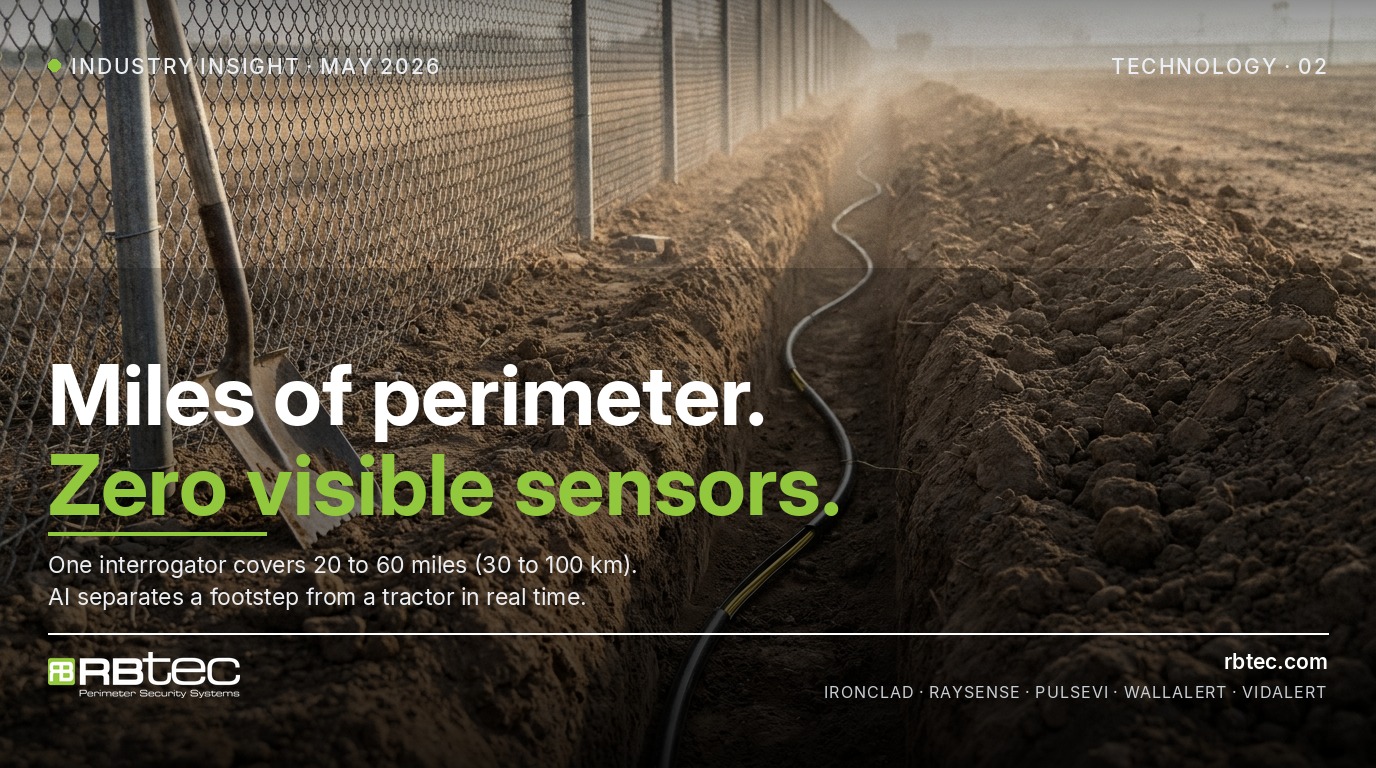
Distributed Acoustic Sensing turns a buried fiber optic cable into a continuous sensor by reading microvibrations in the ground along its length. Footsteps, digging, vehicles, and tampering each produce distinct seismic signatures. A modern AI-classified DAS system separates a person walking from a tractor from a herd of cattle, in real time, with one piece of interrogator hardware sitting in a building somewhere on the site.
What DAS does well: very long distances from a single appliance. Commercial DAS systems regularly cover 20 to 60 miles (30 to 100 km) from a single appliance, and the longest run up to roughly 60 miles (100 km). The cable itself is passive, has no electronics in the field, draws no power along the perimeter, and is immune to electromagnetic interference. For pipelines, substation fence lines, airport boundaries, solar farm perimeters, and any site where the perimeter is measured in miles or kilometers rather than feet or meters, DAS is hard to beat. It is also invisible once buried, which matters for covert applications.
Where DAS struggles: it needs a trench and proper burial. Cable depth, soil compaction, and the distance from the cable to the fence line all affect detection probability and classification. Rocky soil, frozen ground, and frequent surface activity from non-threats (livestock, vehicles, agricultural equipment) all change what tuning looks like. The strength of DAS is the AI classifier, so the install quality and the training data behind the classifier matter more than the headline kilometer number on a datasheet.
RBtec’s DAS lines are RaySense AI DAS (fence-attached fiber) and RaySense Buried (buried fiber). The same interrogator can run both at once.
Ground radar: open ground, all weather, no physical barrier required
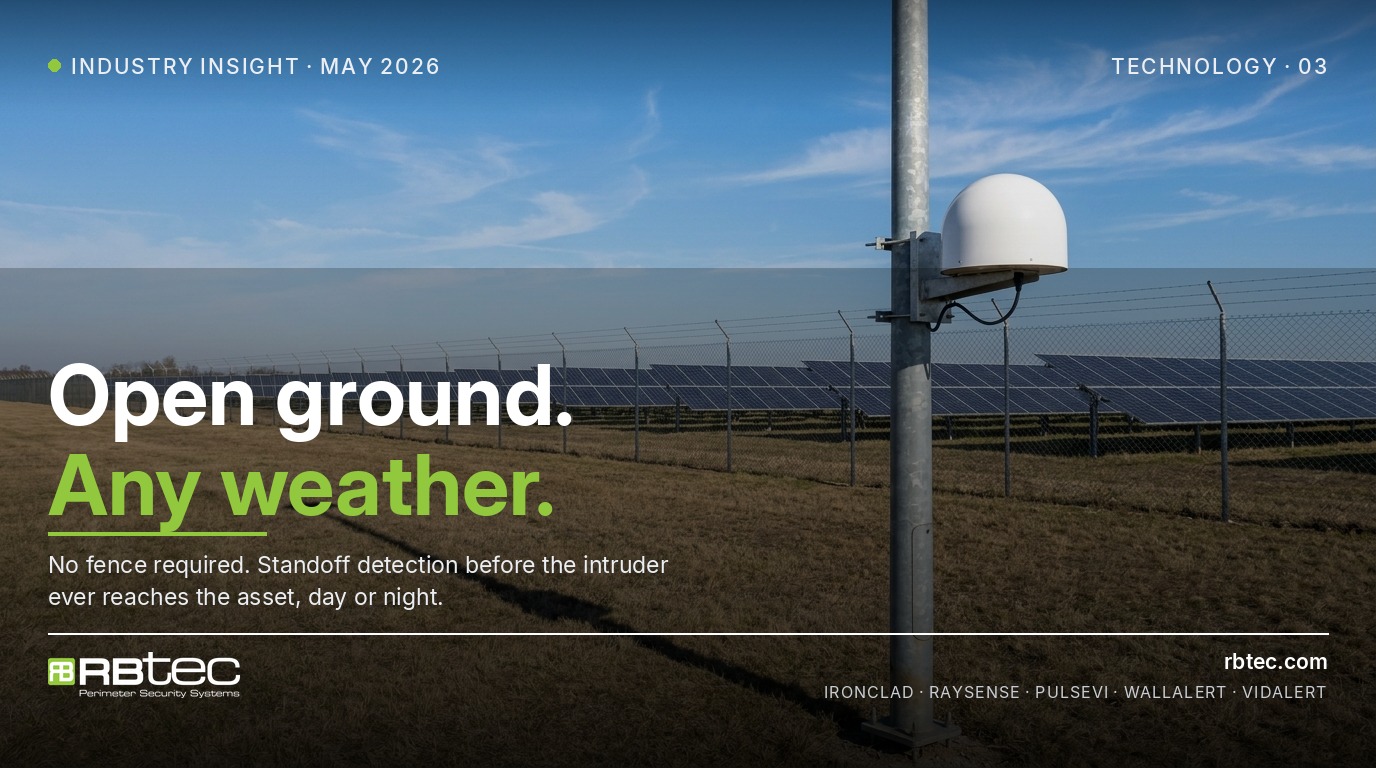
Ground-based radar emits radio energy across a surveillance area and detects moving targets by their reflected signal. Doppler processing separates moving objects from the background. Good radars classify targets by size and motion pattern, distinguishing a person from a vehicle from an animal, and they track multiple targets at once.
What radar does well: it sees through rain, fog, dust, smoke, and total darkness. There is no requirement for a physical barrier, which makes radar a fit for sites where a fence is impractical, undesirable, or far away from the asset being protected. Radar handles open ground well. It is also the right tool when the threat profile demands detection well before someone reaches the fence, for example at a substation, a critical asset within a larger site, or a remote installation.
Where radar struggles: line of sight. Radar needs a relatively clear surveillance volume. Dense vegetation, terrain undulations, buildings, parked vehicles, and equipment yards all create blind zones. Multipath reflections in cluttered environments produce nuisance returns. Wildlife is a real issue at many sites, and the classifier does most of the heavy lifting in rejecting it. Radar also needs space, both physical clearance and a planned site layout.
3D LiDAR: high-precision tracking in a defined volume
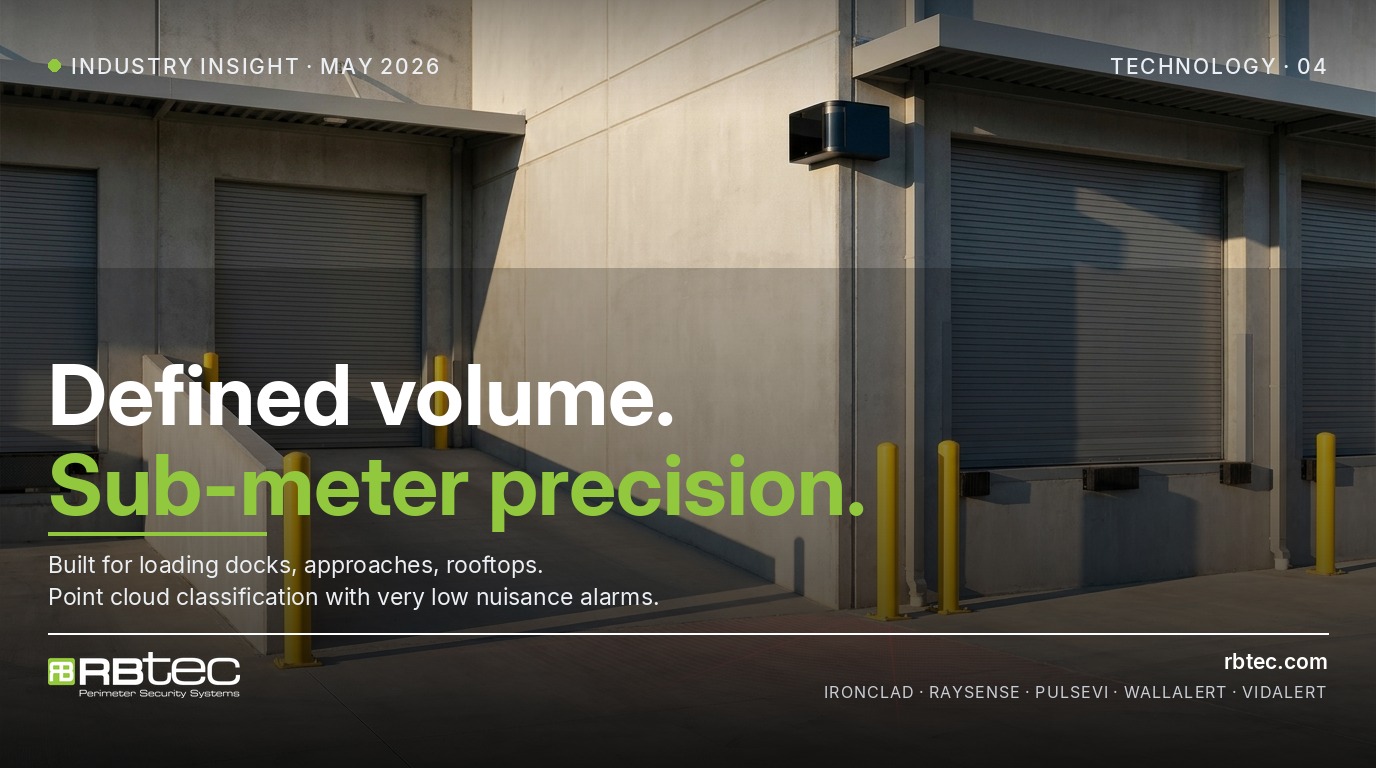
A solid-state 3D LiDAR builds a real-time point cloud of the surveillance area by timing reflected laser pulses. Security LiDARs classify objects by shape, size, and trajectory in 3D, which gives them very low nuisance alarm rates compared with 2D motion detection. Tracking is precise enough to hand off a target to a PTZ camera with sub-meter accuracy.
What LiDAR does well: clean classification in complex environments where false alarms have been a chronic problem. Loading docks, building approaches, internal critical zones, helipads, runway boundaries, and rooftops are all good fits. LiDAR is unaffected by lighting and works in total darkness. It produces a virtual fence with adjustable zones, which lets the operator define a detection zone independent of any physical barrier. Reported false alarm reductions versus camera analytics or 2D motion sensors are large.
Where LiDAR struggles: range. Practical security LiDAR ranges run from about 100 feet (30 m) out to roughly 1,000 feet (300 m), depending on target size and reflectivity. That makes LiDAR a poor choice for a perimeter measured in miles or kilometers, where DAS or radar belong. LiDAR also has performance considerations in heavy precipitation, fog, and snow, because water and ice scatter the laser. The sensor is precise inside its volume and does not pretend to be a long-range tool.
RBtec’s LiDAR product is PulseVi, a 3D solid-state LiDAR for defined zones.
A short decision framework
Start with three questions about the site, not the technology.
How long is the perimeter? Under about 1,600 feet (500 m) and you have many options. Around 1.25 miles (2 km) and you start ruling things out. 12 miles (20 km) and you are talking about DAS or radar.
Is there a usable fence? A fence in good condition opens up the most economical option (fence-mount). A poor fence either gets fixed first or rules fence-mount out of the conversation.
What is the threat profile and the response time the operator needs? If detection must happen before the intruder touches the asset, you need standoff detection (radar or LiDAR over a buffer zone) rather than a tripwire at the fence.
Then layer in environment (weather, terrain, vegetation, electromagnetic interference), operational context (who watches the alarms, what video systems are integrated, what false alarm tolerance the SOC actually has), and compliance (NDAA/TAA, Buy America, CIP-014, insurance audit requirements).
Why most real sites combine layers
A high-security site rarely picks one detection method. A substation might run buried fiber along the property line for early detection, fence-mount on the asset fence for the second line, and 3D LiDAR over the control house for precise final-zone protection. A solar farm might run DAS on the boundary fence and radar over the array. A data center might run fence-mount on the property fence and LiDAR over the loading area and building approaches.
The point is not to install more sensors. The point is that each layer is solving a problem the others cannot solve alone. Cameras then become useful, because the detection layer cues the camera to the right place at the right time. Without that cue, a wall of monitors is just television.
One question worth asking every vendor
What is the probability of detection your system can document at the speed of crawl, in our worst-case environment, with the false alarm rate you will commit to contractually? The vendors who can answer that question with real data are usually the ones worth working with. The ones who answer with a slogan are not.