













Respuesta corta: substation perimeter security works as a layered system — a fence that delays entry, a fence-mounted intrusion detection sensor that reports exactly where the fence is being cut or climbed, a second layer covering the yard and the control building, camera verification of every alarm, and a documented response. For US transmission owners, NERC CIP-014 makes a version of this a compliance obligation. For everyone else — distribution substations, cooperatives, municipal utilities, industrial substations — it is simply what stops copper theft and vandalism from becoming an outage.
Why substation perimeters are being hit
Substations are unmanned, remote, full of copper, and critical. That combination has produced a steady rise in reported incidents.
In the Western Interconnection alone, WECC recorded 220 physical security events in 2024, up from 107 in 2023 — assaults, ballistic damage, intrusion, vandalism, theft and suspicious activity. The overwhelming majority were classified as criminal activity with no grid impact, and under 1% reached the highest severity level. That is the important nuance: most substation incidents are not coordinated attacks on the grid. They are people cutting a fence to get at copper.
The damage is still real. Stolen ground grid copper leaves equipment unearthed and unsafe. A damaged transformer has a lead time measured in months. And a site that is hit once tends to be hit again as soon as the copper is replaced.
What NERC CIP-014 actually requires
CIP-014 applies to Transmission Owners of stations and substations at 500 kV and above, plus 200–499 kV facilities that meet connectivity and weighting tests, and to Transmission Operators of the associated primary control centers. It is built as six requirements:
| Req | What it requires |
|---|---|
| R1 | Risk assessment to identify stations whose loss could cause instability, uncontrolled separation or cascading outages |
| R2 | An unaffiliated third party verifies that R1 assessment |
| R3 | Notify other operators or owners who control identified facilities |
| R4 | Evaluate the physical security threats and vulnerabilities at each identified facility |
| R5 | A documented physical security plan addressing those threats, including law-enforcement coordination and implementation timelines |
| R6 | An unaffiliated third party reviews the R4 evaluation and the R5 plan |
Two things matter for perimeter design. First, R5 asks for measures matched to the threats identified in R4 — not a generic shopping list, which is why “we added cameras” rarely survives a third-party review on its own. Second, R6 means somebody independent will read your plan. A detection system that reports a zone and logs every alarm is far easier to defend in that review than one that reports “perimeter alarm” with no record.
The layered substation perimeter
Layer 1 — Fence and barrier
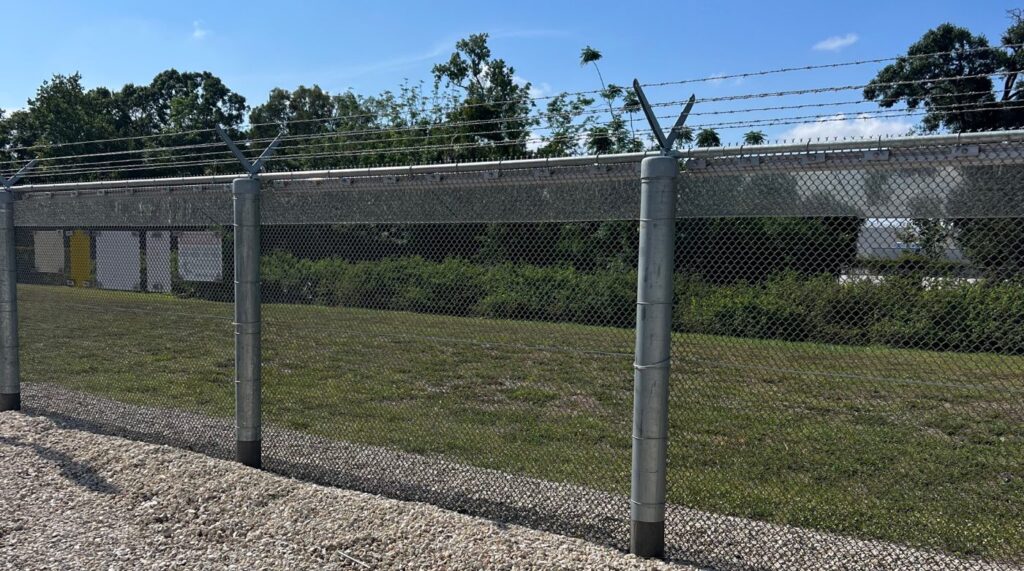
Most substation yards are chain link with barbed wire outriggers, often with a gravel maintenance strip inside. In higher-risk locations that gets upgraded: anti-climb welded mesh, solid ballistic barriers on the sightlines that matter, and vehicle-rated gates. The fence is there to delay and to define the line — it is not detection.
Layer 2 — Fence-line detection
This is the layer that turns a fence into an alarm and tells you where. Choose by fence type and by how many sites you are protecting:
| Valla | Sensor | Por qué |
|---|---|---|
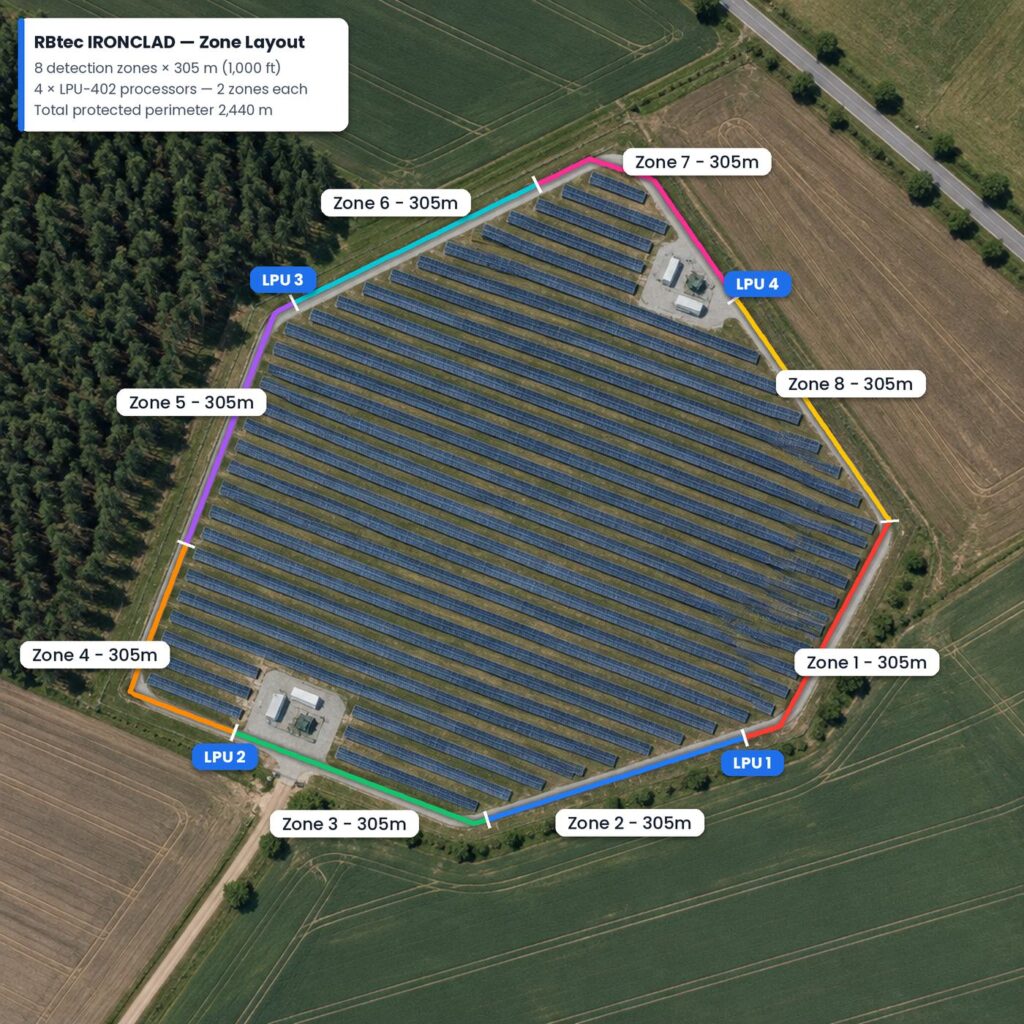
| Chain link, flexible fabric | Sistema de alarma de cerca IRONCLAD | Sensor cable clipped to the fabric; detects cutting, climbing and lifting; LPU-402 / LPU-404 processors, up to 305 m (1,000 ft) per zone |
| Welded mesh, palisade, rigid panel | Cable sensor microfónico MicAlert | Reads the acoustic signature of a cut on rigid fence, rejecting wind and rain |
| Very long perimeters or many sites on one processor | RaySense AI DAS fiber optic sensor | One single-mode fiber optic cable becomes a continuous sensor up to 100 km, with no powered electronics along the fence |

The practical argument for fence-mounted detection at a substation is nuisance alarms. A substation is full of things that move and buzz. Sensors that analyze the vibration or acoustic signature of an attack — rather than simply detecting motion — are what keep a remote site credible to whoever is watching it at 3 a.m.
Layer 3 — Inside the fence
The fence is not the only way in, and the yard is not the only target.
- Sensores de tierra desatendidos Seismo — buried geophones that separate footsteps from vehicles, with nothing visible above ground. Useful across the approach to a gate or around the transformer bay.
- Detección enterrada de fibra óptica RaySense LGDS — detects digging along cable routes, which is how ground grid copper actually gets taken.
- LiDAR 3D PulseVi — classifies humans and vehicles out to 200–300 m in full darkness, for gate approaches and yard volumes.
- WallAlert — vibration detection on the control building itself, where the relays and RTUs live.
Layer 4 — Verification
Every alarm needs a decision within seconds. Because each of the sensors above reports a location, a PTZ camera can be slewed automatically to the zone that alarmed, and the operator sees the fence line rather than hunting across a site map. That hand-off — sensor locates, camera confirms — is the difference between an alarm that gets a response and an alarm that gets acknowledged and forgotten.
Layer 5 — Response
Audio warning at the fence, a documented call-out path, law-enforcement coordination as CIP-014 R5 expects, and an alarm log that shows what happened and when. On repeat-target sites, forensic marking of copper and visible signage measurably reduces re-offending.
The substations nobody assessed
CIP-014 covers a small number of facilities by design. The substations being stripped for copper are mostly the ones below that threshold: distribution substations, cooperative and municipal sites, industrial and data center substations, and switching yards at generating plants.
Nothing obliges those owners to do a CIP-014 style assessment — and nothing stops them either. The same layered approach scales down cleanly, and on a small distribution yard a two-zone fence processor plus a camera is often the entire project.
Designing for a fleet, not one site
Utilities rarely have one substation. They have dozens, and the security budget is per-fleet, not per-site. Three things keep a fleet rollout affordable:
- Standardize the kit. One sensor type per fence type, one processor family, one alarm output. Crews learn it once.
- Report zones, not sites. “Site 14, zone 2, north fence” routes a truck correctly the first time.
- Use existing transport. Substations already have communications back to a control room or SCADA. Dry-contact and IP outputs let perimeter alarms ride the path that is already there, instead of funding a parallel network.
RBtec at utility sites
RBtec fence-mounted detection is installed on investor-owned utility substations, municipal power authorities, electric cooperatives and generating stations across the United States and Canada, and on energy infrastructure internationally — a power station in the United Kingdom, a hydroelectric plant in Laos, a dam in Canada, gas and oil facilities in Mexico and Ecuador, and solar generation across North America and Europe.
Specification checklist
- Fence type, height, length per site and number of gates
- Site count and whether alarms report to a control room, SCADA or a monitoring center
- Required outputs: dry contact, IP/ONVIF, SCADA protocol
- Whether the control building and cable trenches need their own detection
- Power and communications available at the fence line
- Whether the site is CIP-014 identified, and what R4 named as the credible threat
- Environmental: temperature range, lightning exposure, wildlife and vegetation
Preguntas frecuentes
A layered one: a chain link or anti-climb fence, a fence-mounted intrusion detection sensor that reports the zone being attacked, buried or LiDAR detection covering the yard and cable routes, cameras that verify each alarm automatically, and a documented response path. No single technology covers a substation on its own.
No. CIP-014 does not mandate specific products. It requires a risk assessment, a threat and vulnerability evaluation, and a documented physical security plan that addresses the threats identified, reviewed by an unaffiliated third party. Fence-line detection is a common way to satisfy the detection element of that plan, because it produces located, logged alarms.
Detect at the fence before the thief reaches the ground grid, cover the cable routes with buried detection, verify with cameras so a response is actually dispatched, and mark the copper so resale is risky. Fences and cameras alone have a poor record because nobody is watching a remote yard continuously.
Properly installed, no more than occasionally. Microphonic and fiber optic sensors classify the signature of a cut, climb or impact rather than reacting to movement, and buried seismic sensors distinguish footsteps from vehicles. Installation quality and a cleared vegetation strip matter as much as the sensor itself.
Yes, with a distributed acoustic sensing system. A single fiber optic sensing cable can run up to 100 km and cover multiple sites on one processor, which suits utilities with clusters of small substations connected by an existing fiber optic route.
Small yards are usually a single two-zone processor and a few hundred meters of sensor cable, plus a camera at the gate. The cost driver is fence length and the number of verification cameras, not the voltage class of the substation.
Siguiente paso
RBtec has designed and manufactured perimeter intrusion detection since 1986, with fence-mounted, fiber optic, buried and 3D LiDAR detection protecting substations, generating stations and energy infrastructure across North America and worldwide. Send us a site list with fence lengths and fence types and we will return a zone layout and a bill of materials per site. Póngase en contacto con RBtec or read how a cut substation fence played out on camera.