














Was wirklich geschah
Early on Tuesday, September 8, two people cut a hole in the outer chain link fence around the gardens of the Musee Renoir in Cagnes-sur-Mer, on the French Riviera. They went through the hole, crossed the grounds, and reached the paintings. Photographs taken later that morning show police standing beside the opening in the fence fabric.
An alarm was triggered at 5:48 a.m. Police were on scene within five minutes. The suspects were already gone. Four works came off the walls, and two of those were dropped in the gardens during the escape, so two were actually carried away. The local mayor, Bryan Masson, described a well equipped and apparently well informed team carrying an electric knife or metal saw, which they used on the bolts holding the frames in place. The city’s video surveillance cameras picked the pair up as they fled.
The museum is closed until further notice, and the mayor has said the incident confirms the need for a broader plan to secure the town’s museums.
Die Entdeckungslücke
Read the sequence in order and the gap is easy to find.
The first physical event of that night was not a door, a display case, or a motion sensor in a gallery. It was a blade going through chain link at the edge of the property. Everything after it, the walk across the garden, the entry, the work on the frames, ran on time the intruders were handed by a fence cut that nothing reported.
The alarm that did fire, and the response it produced, both worked. Five minutes is fast. The museum’s alarms are credited with cutting the theft short, and the city cameras gave investigators images of the getaway. None of that is a failure of cameras or of interior alarms. Cameras verify what they can see and supply evidence after the fact, and that is exactly what they did here. The problem is narrower than that. The clock started too late. By the time anything reported an intrusion, the team was standing in front of the artwork.
A perimeter that is only a physical barrier is a delay, not a detection layer. If nothing reports the moment it is breached, the delay it buys goes to the intruder.
Wie IRONCLAD dieses Problem löst
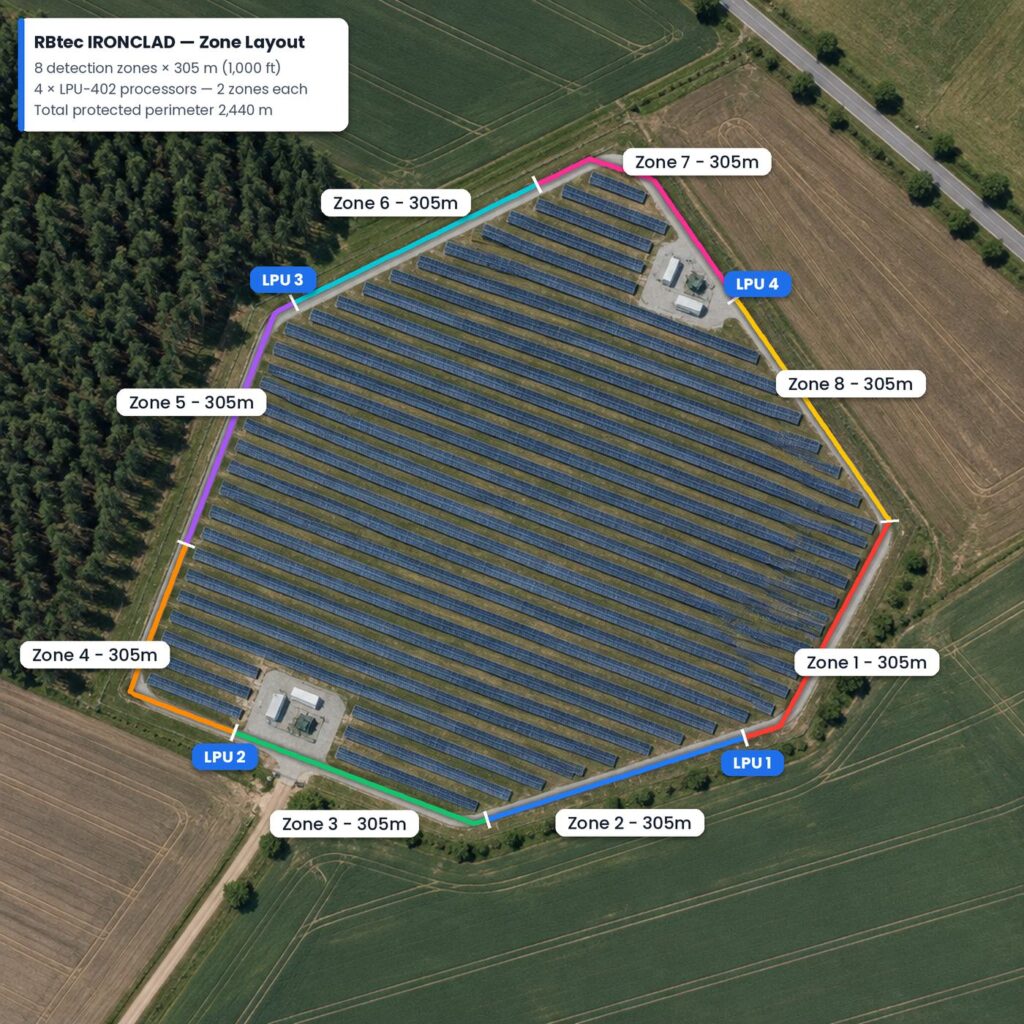
IRONCLAD is a fence mounted intrusion detection system that attaches to existing chain link and reports the mechanical signature of an attack on the fence itself: cutting, climbing, lifting the fabric. It does not require a new barrier. On the Musee Renoir’s garden boundary it would have been mounted on the same fence the suspects cut.
The alert would have come at the cut. A saw or cutter opening the fabric produces the kind of vibration signature the sensor is built to report, and the system localizes it to a zone, so the alarm names a stretch of boundary rather than saying only that something happened somewhere. In this incident that alert would have landed while the suspects were still out on the garden side of the building, ahead of the 5:48 a.m. alarm. The same five minute police response would then have been running against a different clock.
To be plain about the limits: nothing here stops two determined people from cutting a fence, and no detection system guarantees an arrest. What it changes is when the first person finds out. On a long perimeter, RaySense fiber optic fence detection closes the same gap with a single sensing cable over much greater distances.
Was Anlagenbetreiber fragen sollten
- Is anything on our outer boundary reporting a breach, or does our first alert come from inside the building?
- If our fence were cut tonight, would the alarm tell us which section?
- How much of our security plan assumes an intruder will be seen on camera before reaching the asset?
- Do our response procedures assume an alert at the perimeter, or an alert at the display case?
Das Fazit
The Renoir Museum had an alarm that worked and cameras that produced usable images, and it still lost two paintings, because the first thing that happened that night was invisible to all of it. Detection belongs on the line the intruder crosses first. See how other sites have closed this gap, or talk to us about your perimeter.