













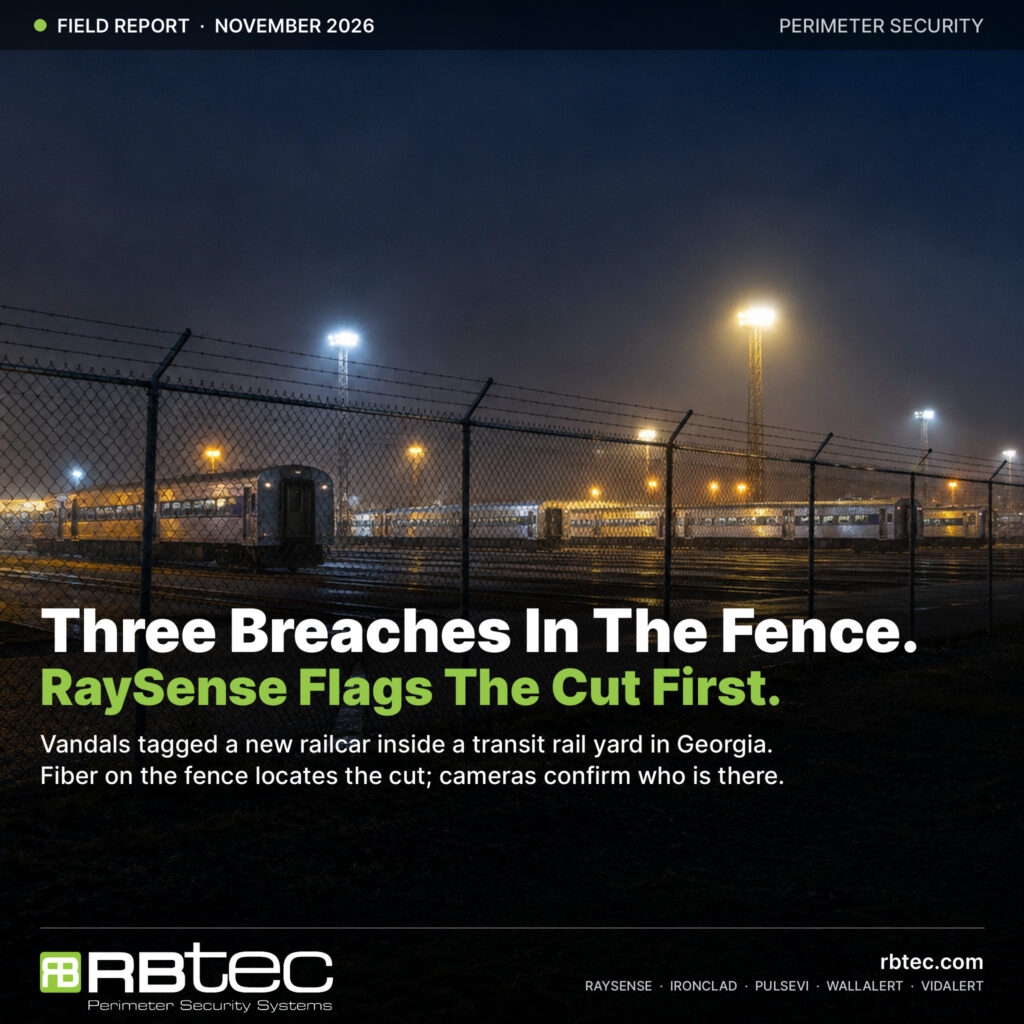
Just after midnight on Oct. 4, a MARTA train operator found fresh graffiti on one of the transit agency’s new railcars at South Yard in College Park, Georgia. The paint was already dry. When officers walked the perimeter afterward, they found the yard’s fence breached in three places. Nobody had known the fence was open until the train was already tagged.
Ce qui s'est réellement passé
The Atlanta Journal-Constitution reported on Oct. 29 that a new CQ400 railcar was found tagged at South Yard on Oct. 4, the second time the new trains had been vandalized this year. Police could not tell when the car was painted. Officers photographed the fence breaches before the car was cleaned. On Oct. 19, photos of the tagged car were posted to Instagram, showing two people in dark clothing, one wearing a face mask. No arrests have been made.
MARTA has recorded 15 vandalism incidents at its rail yards in 2026, all at South Yard or Armour Yard. Police believe most trespassers got in through holes cut in the barbed-wire fences. In April, officers found a large hole in one South Yard fence and a missing section of barbed wire on another side. In March, according to Atlanta News First, surveillance video captured two people tagging a new car while officers were at the yard but out of view. MARTA said the cars have an anti-graffiti coating, and the paint came off in a couple of hours.
Le vide de détection
Records describe fencing and video surveillance in the yards, and MARTA police say they patrol them regularly. What the yard lacked was an early signal. In the October case the first signal was a train operator noticing paint, and the fence breaches were found after that. A fence that has been cut does not report itself. Unless someone happens to walk past the right section, a hole can stay open for hours or days.
Cameras are useful here. They verify what they can see, and the March footage shows how much a camera can record. A rail yard is a hard place to watch by eye, though: long fence lines, parked trains blocking sightlines and patchy lighting at night. Camera analytics can help, but they depend on placement, light, distance and tuning, and someone still has to be told where to look.
Comment RaySense répond à ce problème
RaySense is a fiber optic fence sensor. A standard single-mode fiber cable is attached to the fence fabric, and the cable itself is the sensor, with no power or electronics along the fence. A rack-mounted processing unit reads the vibrations along the cable, uses AI to tell cutting and climbing apart from wind and passing trains, and locates each event to within about 10 feet. One unit covers up to 100 kilometers, which suits a long rail yard perimeter.
At South Yard, cable on the fence fabric would register cutting or climbing at each of the three points that were later found breached, as it happened, and report each location. Through a VMS or Vidalert, the alarm can call up the nearest camera, so an operator sees who is at that section and sends a patrol while the intruders are still at the fence line, before anyone reaches a railcar.
The cable has to be installed and calibrated on the actual fence, and a slack or damaged fence weakens the signal. Rail yards are noisy places, which is why the system has to be tuned to the site. An alarm does not stop anyone by itself. Its value depends on who receives it and how fast they can respond.
Les questions que doivent poser les exploitants de sites
If someone cut our fence tonight, what would tell us, and how soon? Could we say which section was cut, or only that something happened somewhere? Which camera would an alarm bring up, and who sees it at 2 a.m.? How many breaches have we found on patrol that nobody noticed being made? How long can a hole in our fence stay open before someone finds it?
En résumé
At South Yard, the fence was breached in three places and the first sign was dry paint on a new train. A RaySense cable on that fence moves the first signal to the cut itself, with a location, and cameras confirm who is there. The same approach fits bus depots, freight yards and other long perimeters where a hole can go unseen. To talk through a layout for your yard, contactez RBtec.