












IRONCLAD Fence Alarm System

The IRONCLAD Fence Alarm System is a fence-mounted sensor cable system that detects intrusion attempts (cutting, climbing, or lifting) directly at the fence line.

Experience perimeter security that simply works with the IRONCLAD Fence Alarm System, a plug-and-play solution for reliable intrusion detection. Designed as a true plug-and-play system, the IRONCLAD eliminates the need for expensive training, certification, or special tools. Just install the sensor cable and the system self-calibrates to your fence immediately. 

Unlike complicated alternatives, this armored fence alarm uses a proprietary algorithm with three layers of filtering to detect cutting, climbing, or lifting attempts while filtering out false alarms caused by wind, rain, and other weather conditions. It integrates seamlessly with your existing infrastructure, connecting via dry contact relays to any standard burglar alarm, DVR, or SCADA system you already own. 

IRONCLAD Banner

How Does the IRONCLAD Fence Alarm System Detect Intruders

The system uses three layers of false-alarm filtering. 

1. The detection algorithm is designed to detect only sharp frequency vibrations associated with intrusion attempts, while filtering out the low frequencies caused by weather conditions.

2. Automatic real-time alarm threshold adjustment with wind rejection.

3. 500 sensitivity levels are easily adjusted to adapt the sensor sensitivity to the fence condition.

Solar farm perimeter protected by RBtec fence-mounted detection system

Fence Alarm System Sensor Layout:

  1. The sensor cable comes pre-cut in 250 ft (75 m), 500 ft (152 m), or 1,000 ft (305 m) lengths.

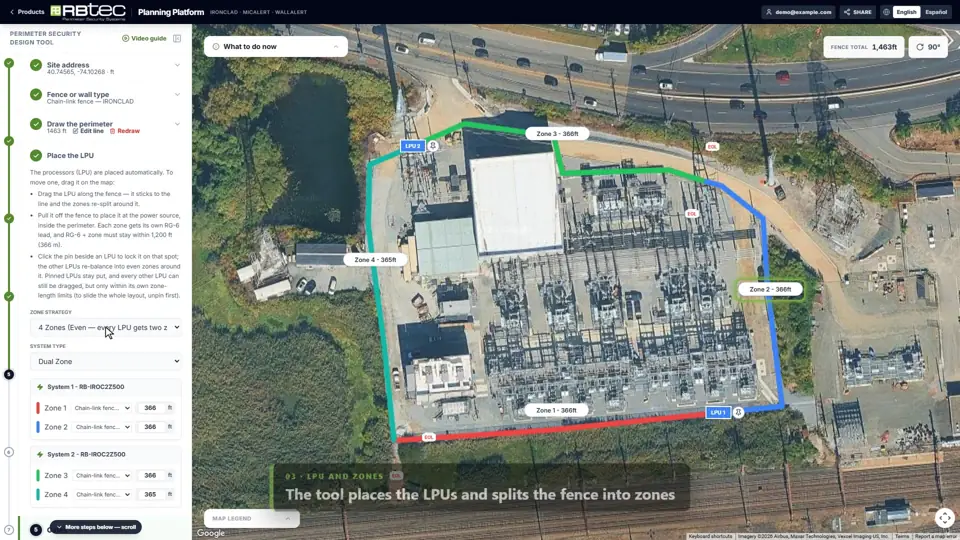
  2. Each LPU processor (analyzer) monitors up to two zones (two spools).

  3. Each processor supports up to 2,000 ft (600 m) total, split across two zones of up to 1,000 ft (305 m) each.

  4. Each kit includes an LPU processor in a weatherproof enclosure, plus the selected sensor cable length.

  5. For larger perimeters, you can combine as many kits as needed.

Innovative Solutions for Every Need

Purpose built perimeter detection for the industries where a breach costs the most.
Explore how RBtec fits yours:

Here are five reasons why security cameras are not enough (Even with Video Analytics!)

Person vs. Intention

Cameras identify a human shape, but a sensor cable detects the physical act of climbing or cutting. One is a picture; the other is a confirmed breach

Environmental "Blindness"

Heavy rain, dense fog, and snow can spoof even the best AI analytics. Detection does not depend on line of sight, so darkness, fog, glare and smoke do not affect it.

The "Masking" Problem

Intruders now use anti-AI clothing or simple masks to bypass facial and skeletal recognition. A sensor cable doesn't care what an intruder looks like, it only detects the physical force of the climb.

Visual Blind Spots

Video analytics are limited by "line of sight" and lighting. A sensor cable provides unbroken, 360° linear protection along your entire fence, eliminating the "dead zones" where AI loses track.

Hidden Costs

Modern analytics require expensive per-camera licenses and massive 4K cloud storage fees. The IRONCLAD system is a one-time hardware investment with zero recurring storage or licensing costs.

IRONCLAD RB-IROC2Z250 fence alarm sensor unit

Unique features of the IRONCLAD system

  • Armored Sensor Design: The sensor cable includes a built-in steel mesh layer that provides heavy-duty physical protection without needing extra conduits.

  • Smart Weather Filtering: The system automatically ignores vibrations caused by wind, rain, or hail, ensuring that only real security threats trigger an alarm.

  • Easy Maintenance Boards: The processor uses a modular design with swappable internal boards, making it much faster and cheaper to repair or upgrade in the field.

  • Flexible Setup Options: You can adjust the system’s sensitivity directly on the device using buttons or use specialized software for more precise tuning.

  • Proven Durability: The system is built to last with a certified 80,000-hour reliability rating and a 10-year warranty on the sensing cable.

RBtec’s Partners Worldwide
RBtec perimeter security system protecting a fenced facility
RBtec fence-mounted detection technology close-up

More Information About the IRONCLAD Fence Alarm System

A fence alarm system is a perimeter security system that detects intrusion attempts directly on the fence line.

Instead of waiting until an intruder reaches a building, storage area, substation, solar farm, airport, data center, or other protected asset, a fence alarm system provides early warning at the perimeter.

A fence-mounted intrusion detection system is designed to detect physical attacks on the fence, such as climbing, cutting, lifting, or jumping over. This makes the fence an active security layer instead of only a physical barrier.

IRONCLAD is a fence-mounted perimeter intrusion detection system that uses a sensor cable installed on the existing fence. The system detects fence vibrations caused by intrusion attempts and sends an alarm to the connected security system.

A fence alarm system is useful for sites that need outdoor asset protection, perimeter monitoring, and faster response before an intruder enters the protected area.

  • The IRONCLAD Fence Alarm System uses a vibration sensor cable mounted directly on the fence.

    When someone cuts, climbs, lifts, or jumps over the fence, the sensor cable detects the vibration pattern created by the intrusion attempt. The processor analyzes the signal and activates an alarm when the activity matches intrusion behavior.

    The IRONCLAD sensor cable is fully wrapped with stainless-steel braid for mechanical protection in outdoor fence installations. It is suitable for chain link fences, welded mesh fences, razor wire, and concertina coils.

    Each IRONCLAD processor supports up to two detection zones. This allows a perimeter to be divided into smaller alarm areas, making it easier for security teams to identify the intrusion location and respond quickly.

    IRONCLAD can be used as a standalone fence alarm system or integrated into a larger perimeter security system.

Outdoor perimeter security systems must detect real intrusion attempts while reducing nuisance alarms from wind, weather, animals, and normal fence movement.

IRONCLAD uses signal processing and adjustable sensitivity settings to help identify intrusion-related fence vibrations. The system is designed to reduce false alarms while maintaining reliable detection of cutting, climbing, lifting, and jumping attempts.

No sophisticated calibration is required. Installers can adjust the sensitivity of each zone on-site based on the fence type, fence condition, environment, and security level required.

This makes IRONCLAD a practical fence intrusion detection system for locations that need reliable outdoor detection without complex setup or constant maintenance.

IRONCLAD is used to protect fenced sites where early warning and perimeter intrusion detection are critical.

Common applications include utility substations, solar farms, data centers, airports, correctional facilities, industrial sites, commercial properties, equipment yards, construction machinery storage, RV and boat storage facilities, communication towers, cellular sites, border areas, and other high-security perimeters.

The system is installed on the existing fence line and is available in different sensor cable lengths. Larger sites can be protected by using multiple processors and dividing the perimeter into detection zones.

Gate kits are available for swing gates and sliding gates, allowing the fence alarm system to continue protecting access points.

Optional accessories include stainless steel twist ties, gate kits, and solar/wireless kit options for remote locations where power or communication infrastructure may be limited.

IRONCLAD integrates with alarm panels, CCTV systems, video management systems, NVRs, access control systems, sirens, lights, and other security equipment using dry-contact relay outputs. This allows the system to trigger cameras, alerts, notifications, or response actions when an intrusion is detected.

IRONCLAD Detection in the Wind – Solar Farm
RBtec IRONCLAD Perimeter Protection System
IRONCLAD Train Test – Security in Harsh Environment
¿Cómo funciona un sensor perimetral exterior? Protección avanzada para exteriores
RBtec IRONCLAD Demonstration – Perimeter Protection System for Fences – Perimeter Security System
IRONCLAD Fence Alarm System DEMO for Perimeter Intrusion Detection
Operating Power Requirements

12 – 24VDC 300mA @ 12VDC

Lightning Protection:
  • 2 Layer Surge Protection
  • Gas discharge devices are on all inputs/outputs and communication lines.
Alarm Inputs
  • 2/4 IRONCLAD sensor cable inputs.
  • 4 Intrusion and Line monitoring for accessories like magnets, contact, microwaves, and motion detectors.
  • 1 Tamper switch.
Zone Status & Sensitivity Levels
  • 8x Arm/Disarm via Jumper
  • Twenty-two levels of sensitivity per zone on board.
  • 500 Levels of sensitivity via software
  • 1 Power Outage relay.
Communication to PC
  • USB-C Input
  • Optional RS485 or IP
Alarm Outputs
  • 8x Dry contact relays with contacts rated 1A @ 12VDC.
  • 1x Tamper switch relay
  • 1x Power Outage relay.
Connector:
  • Sensor Input – 8x Screw terminal – Pair per zone.
  • Alarm Output – 8x Screw terminal – Pair per zon
Cable:
  • Outer Diameter – 1/4 Inch (6mm).
  • Color: Metallic Silver
Enclosure:
  • NEMA 4X, IP-66
  • 9.5 x 7.5 x 2.75” (24 x 19.5 x 7.0cm)
  • Weight: 2.2 lbs. (1Kg)
Environment:
  • Operating Temperature: – 40° to 221°F (-40° to 105°C)
  • Relative Humidity up to 9

RBtec IRONCLAD Demonstration – Perimeter Protection System for Fences – Perimeter Security System
IRONCLAD Fence Alarm System DEMO for Perimeter Intrusion Detection

Connecting IRONCLAD is straightforward. Each LPU analyzer/processor provides 2 or 4 dry-contact relay alarm outputs (NO/NC), one per zone. Because they’re standard dry-contact outputs, they work with virtually any system you may already have: alarm panels, CCTV, access control, sirens, strobe lights, even fire alarms. In other words, IRONCLAD fits into your existing setup rather than forcing you to replace it.

Whatever the size of your perimeter, IRONCLAD scales to fit. The sensor cable comes in spools of 250 ft (75 m), 500 ft (150 m), and 1000 ft (300 m). Each processor monitors up to 2 zones, so a single kit covers up to 2000 ft (600 m), and for larger sites, multiple kits simply combine to protect the entire fence line. From a single gate to miles of perimeter, the system grows with your needs.

Yes, and it’s easy. You can fine-tune sensitivity right on the LPU (Local Processor Unit) across 20 levels, or through the calibration software across 500 levels, so the system is dialed in precisely to your fence and environment. No special tools and no technical background required; if your needs change, you can simply readjust.

No. IRONCLAD does the hard part for you. It automatically self-calibrates a baseline, and from there you only set the sensitivity you want. It’s a true plug-and-play system: connect power, sensor inputs, and relay outputs, and you’re protected.

No. The IRONCLAD detects only the sharp, high-frequency vibrations generated by cutting, climbing, or jumping a fence. Wind, rain, and small animals typically produce long-wave, low-frequency vibrations that the system ignores. It’s the difference between someone climbing the fence (detected) and the wind pushing on it (not detected). An optional weather station can also feed the analyzer real-time weather data to compensate for wind and rain, giving an even higher level of false-alarm filtering.

The IRONCLAD works with most fence types, including chain link, welded mesh, and palisade. For the best results, the fence should be in good condition: intact, straight, under tension, and free of obstructions. If you have a rigid metal fence, we’ve got you covered there too with the MICALERT Microphonic Rigid Fence Sensor Cable.

Don’t worry, this is almost always an easy fix. Start by confirming the sensor cable is installed snugly with no slack or air gaps, check for any loose connections, keep the fence clear of external noise sources, and add a ground to the negative of the DC power. From there you can fine-tune the sensitivity. And if anything still isn’t right, our team is happy to help you get it sorted.

Choosing the right parts is simpler than it looks, and you won’t have to guess. Our code tables, the Site & System Design Manual, and our team are all here to help you put together exactly the right kit for your fence.

Site & System Design Manual

Where to buy?

Option 1 – Swing gate with NO conduit

Protection of an emergency gate or rarely used can be done by using the gate connector (sold separately), the connector will be connected to the cable at the opening point of the gate to allow the gate to be opened or closed. It’s not recommended to use this connection on often used gates.

Option 2 – Swing gate with WITH conduit

A single or double swing gate is protected in the same method.
The sensor cable is looped on the gate, then connected to a junction box RB-RBMCTXT and spliced with an RG6 direct burial to go under the gate, on the other end, it is spliced back to a sensor cable and looped on the other side of the gate.
On the hinges, enough sensors need to be left to allow it to move freely with the gate opening and closing so the cable won’t stretch or bend sharply.

Option 3 – Sliding gate with WITH conduit

Sliding gates can be treated in 2 ways

1. Bypass the gate and put a motion sensor across the gate to protect the crossing.
2. Use the RBtec sliding gate kit. A sliding gate is designed for light to medium traffic gates. Heavily used gates with hundreds of openings a day must be protected with another technology, such as a camera or motion sensor.

Video showing the Operation of the Sliding Gate Kit

Installation is quick and predictable: typically about 1 hour per 300 ft (100 m) of cable. Following the step-by-step installation guide makes the process simple and ensures everything performs as it should. Log in to download the IRONCLAD  Installation Manual

Yes, the cable is flexible to your fence, not the other way around. While it’s sold in fixed spool lengths, you can cut it to any length you need. It’s a simple 2-conductor copper wire, so customizing the run to your site is easy.

Not at all. If you’d prefer to bypass a gate entirely instead of using the RBtec gate connector, you can simply run direct-burial RG6 as a non-sensitive conduit through that section. It’s a clean, simple solution.

Absolutely, and it takes only about 30 seconds. RBtec’s repair kit (RB-RBMCTXT) bridges the cut in a fully weatherproof way, so performance is maintained. The repair box installs right at the cut point, the sensor cable connects to screw terminals on each side, and your system is back up and running with no need to replace the whole run.

Still have questions?

Explore our Security Solutions page or contact us at +1 (301) 760-4016. Our dedicated team is ready to help you with all your security needs, discreetly and professionally.

Basic Guide to Troubleshooting False Alarms in IRONCLAD Security Systems

Many times, false alarms in security systems like IRONCLAD are not merely due to sensitivity settings but are often caused by technical issues with the system or its surroundings. Lowering the sensitivity frequently doesn’t solve the underlying issue but merely masks it. Therefore, it’s crucial to systematically investigate and address potential technical and environmental factors contributing to false alarms.

Ensure the fence is in good condition – fully intact, straight, under tension, and free of obstructions. Loose signs or debris can cause false alarms.

Verify the sensor cable is properly installed – it should be attached mid-height, run parallel to the ground, and have no slack. Ensure ties are secure but not over-tightened.

Look for any damaged or loosely connected sections of the sensor cable. Ensure all end-of-line terminations are correctly installed as per the manual.

Disconnect the sensor wire from the LPU and measure its resistance. The proper resistance should match the end-of-line resistor, which is typically 1M ohm. A discrepancy indicates issues with the sensor wire or connections.

 Check if the sensor sensitivity is set appropriately. Overly sensitive settings can lead to false alarms. Use the LPU-400 calibration software to adjust if necessary.

Check the power source for noise. Ground the negative of the DC voltage to eliminate noise from the power source. If this doesn’t resolve the issue, test the system with a 12V DC battery. If using a battery solves the problem, consider permanently grounding or replacing the power supply.

Assess the fence’s surroundings for elements that could trigger false alarms, such as loose signs, items hitting the fence during windy conditions, metal-to-metal rattling, heavy branches slapping the fence, loose barb wires, cables, or any other items hung on or near the fence. These factors can physically interact with the fence and contribute to false alarms, especially in adverse weather conditions.

Conduct regular system tests to ensure proper operation and adjust sensitivity levels as needed.

This comprehensive approach should effectively help you identify and address the source of false alarms in your IRONCLAD system.

Personal Information

Project Information

Protect Your Site with RBtec

RBtec delivers innovative perimeter security solutions trusted worldwide. With over 5,000 systems installed in 57 countries, our products combine reliability, cost-effectiveness, and user-friendly design for any site size or risk level.