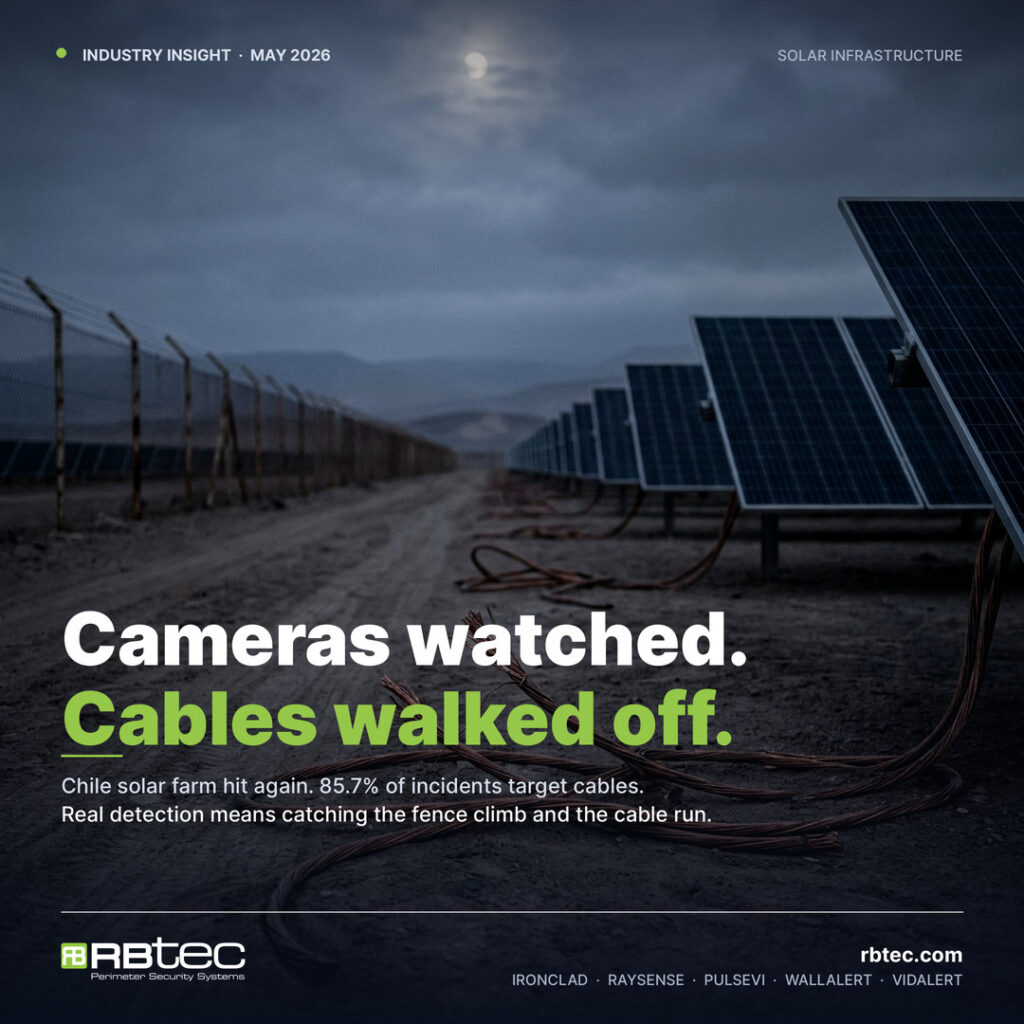















Solar farms in Chile have become a target for organized copper theft crews, and the way these jobs are being run says more about perimeter security than about copper prices.
What actually happened
Bloomberg’s reporting and follow-up coverage in Insurance Journal (May 7, 2026) describe a string of overnight thefts at solar facilities north of Santiago and across the Atacama Desert. At one site, the Eléctrica Altos de Til Til solar farm, operators counted three breaches in roughly six months. The pattern is consistent. Two men in coveralls and gloves scale an electric perimeter fence. They locate and disable the cameras. A second crew uses poultry shears and an electric angle grinder to cut through the main gate. Three pickups without plates pull in, and the team loads copper cable and dozens of panels before vanishing into the dunes. Police typically arrive in under an hour. By then the trucks are gone.
The detection gap
The thing worth focusing on is not what was stolen. It is when the response started. A fence delays entry by a couple of minutes. A camera records what is already happening. A motion light tells the crew where they are. None of those layers raise an alarm the second a hand grips the fence fabric or the second a cable is exposed underground. By the time a guard scrolls back through footage or a monitoring center places a call, the window is closed.
Solar sites make this worse on purpose. They are sprawling, remote, and largely dark from midnight to dawn. Patrols are thin. The footprint that makes the project economical is the same footprint that gives a crew an hour to work undisturbed.
How RBtec’s perimeter detection addresses this
The answer is not more cameras. It is detection at the line itself, in real time, with location precision. RBtec’s IRONCLAD fence-mounted detection system reads vibration on the fence fabric and classifies the signal at the point of contact. When the fence flexes from a climb attempt or a cut, the alarm fires within the same second and pinpoints the zone. Cameras then become useful because they slew to a known location with a known event already attached.
For the cable runs themselves, RaySense buried fiber-optic detection covers the trenches between panels, the access roads, and the cable corridors. A spade hitting the soil above a buried cable generates a signal the system can hear and locate. Drag a cable in the open and it is a camera problem. Touch the dirt above one and it is a detection event.
What facility owners should ask
For anyone running or designing a solar site in Latin America right now, three questions cut through a lot of vendor noise:
Does the perimeter raise an alarm at the moment of contact, or only afterward? If the answer involves video analytics on a recorded stream, that is detection after the fact.
Where does the alarm land, and how fast does it reach a responder? A 90-second internal handoff is the difference between catching a crew at the fence and reading about the theft in the morning.
Are buried assets monitored, or only the visible ones? Most solar copper losses come from cable runs, not from the panels themselves. Buried detection covers the asset that is actually being stolen.
The bottom line
Chile’s solar theft wave is not a copper price story. It is a perimeter detection story. The crews are working a fixed playbook because the perimeter design lets them. Real-time fence detection plus buried cable monitoring change the math, because the alarm reaches a responder before the trucks are loaded. Operators who want to read more about how this stacks up at real sites can browse our case studies for examples from utility, infrastructure, and energy installations.