













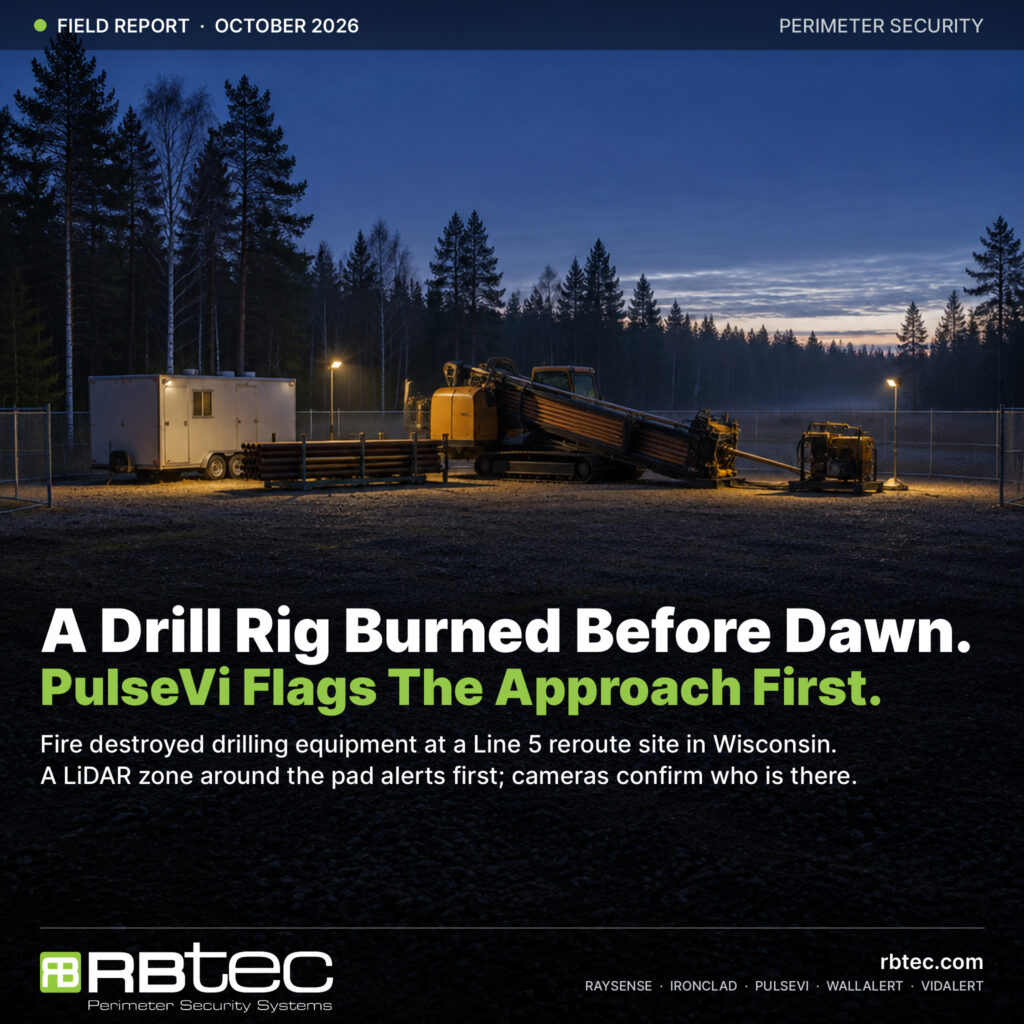
An early-morning fire on October 12 destroyed a drill rig and support equipment at a worksite on Enbridge’s Line 5 reroute in northern Wisconsin. Enbridge called it vandalism. It is the second drill rig lost to fire on the project in less than a month.
What Actually Happened
According to Wisconsin Public Radio, the Ashland County Sheriff’s Office put the fire at around 5:20 a.m. near Wilson Road in the town of White River. It destroyed a horizontal directional drill rig and related equipment, including an equipment trailer and two boring machines. No one was injured.
Enbridge spokesperson Juli Kellner said graffiti was found at the site and called the fire the second major vandalism involving construction equipment on the roughly $1 billion reroute project. WPR reports that a separate fire destroyed a drill rig at another Ashland County directional drilling site on September 17, and that the FBI and ATF are investigating two September fires. The October fire is under investigation by local law enforcement. Enbridge said Line 5 continues to operate.
The Detection Gap
A directional drilling pad is a temporary site, and its equipment stays on it overnight after the crew leaves. The public reports describe the fire and what it destroyed. They do not say whether the pad had cameras, guards or an intrusion alarm, or whether anyone knew a person was on site before the fire started.
If cameras were there, their footage may help investigators. Cameras verify what they can see, and on a dark, wooded pad that depends on lighting, line of sight, distance and how the analytics were set up. Before dawn, with no crew on site, the first sign of trouble can easily be the fire itself.
How PulseVi Addresses This
PulseVi is a 3D solid-state LiDAR sensor. It emits its own eye-safe laser pulses, so it works in full darkness without site lighting. It refreshes at up to 30 frames per second, ranges up to 300 meters, and uses AI classification to tell people and vehicles apart. Detection zones are 3D volumes drawn in software, so no fence is needed to mount them on.
For a drill pad, the fitting layout is the parallel virtual fence. Sensors mounted high on poles or masts at the pad’s corners project a detection corridor around the boundary, outside the rig, trailers and pipe racks. Applied to October 12, the first alarm would come when a person stepped into that corridor at an hour when the pad should be empty, before they reached the rig. The alarm carries a location. Through a VMS or Vidalert, it can bring up the camera covering that side, so a monitoring operator sees who is there and calls the sheriff while the person is still at the edge of the pad.
A temporary pad needs power and a network path for each sensor, and the mounts have to be rigid. Equipment, berms and trees block line of sight, so the corridor has to be laid out around them and commissioned on the actual site, then adjusted when the layout changes. In a rural county, a deputy may be a long drive away. The sensor does not stop anyone by itself. It gives whoever receives the alarm a head start, with the first call coming while a person is still at the pad edge.
What Facility Owners Should Ask
If someone walked onto our drill pad at 4 a.m., who would know, and how fast? Do our cameras send live alerts to a person, or do they mostly record? Which sides of the site are dark or blocked by equipment? When the pad moves to the next crossing, does the detection move with it? Who receives an alarm overnight, and what do they do in the first five minutes?
The Bottom Line
On the Line 5 reroute, two drill rigs have burned in under a month, and the public account of the latest fire starts with the fire. A PulseVi corridor around a drill pad puts the alert at the first step onto the site, and cameras confirm who it is. To talk through a layout for a remote construction or pipeline site, contact RBtec.