















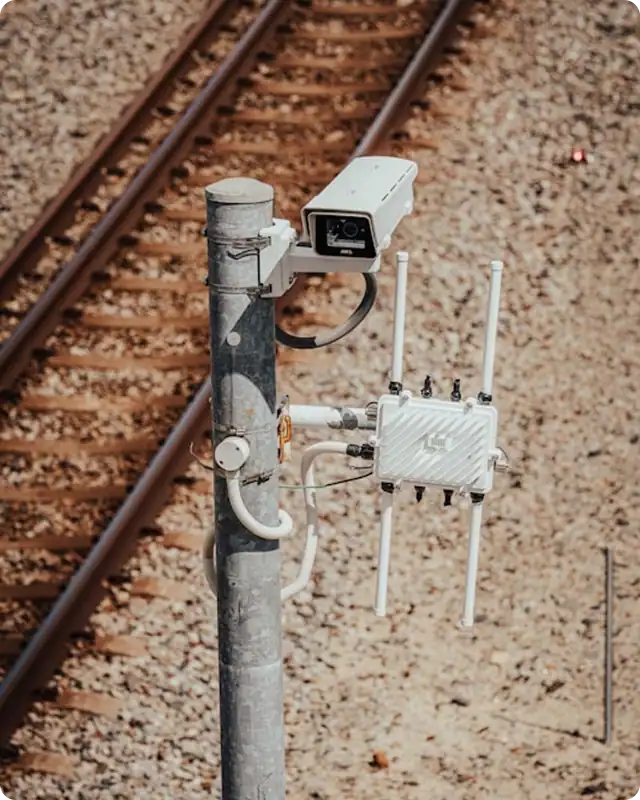
Perimeter security is everything that keeps unauthorized people and vehicles outside a site’s boundary: the fence or wall, gates and access control, lighting, cameras, guards, and the sensors that raise an alarm when someone tries to get through. This guide covers the sensor part, the perimeter intrusion detection system (PIDS), because it decides how early your team finds out. It explains the main types of perimeter security technology, where each one fits, and how to choose between them.
How perimeter security systems are layered
Security planners often describe perimeter protection as five layers, known as the 5 Ds:
- Deter: visible fencing, signage, lighting and cameras discourage an attempt.
- Detect: sensors on or near the boundary alarm when someone cuts, climbs, lifts or digs.
- Delay: fences, walls and barriers slow the intruder and buy response time.
- Deny: access control and locks keep unauthorized people out of critical areas.
- Defend: guards, police or a monitoring center respond to the alarm.
Delay only helps when someone knows it has started. A fence cut at 2 a.m. with no sensor on it is usually found the next morning, after the intruder has left.
What is a perimeter intrusion detection system?
A perimeter intrusion detection system is a set of sensors along a boundary, divided into zones. When a sensor picks up an intrusion attempt, the processor sends a perimeter alarm for that zone to your alarm panel, video management system (VMS) or monitoring center. Cameras then verify what happened, and the zone tells the responder where to look. Fiber optic systems go further and locate the event at a point along the cable.
Two questions decide whether perimeter detection works in practice: how reliably it catches real attempts, and how rarely it alarms on wind, rain, animals and normal site traffic. Every technology below handles the second question differently, so the boundary type is the first thing to decide.
Types of perimeter security technology
RBtec makes sensors for each kind of boundary. The table groups them by where they install.
| Technology | Where it installs | RBtec product and what it detects |
|---|---|---|
| Fence-mounted sensor cable | Chain link, welded mesh and razor wire fences | IRONCLAD: cutting, climbing and lifting. Sold in kits, 2 zones per processor, dry-contact relays to any alarm panel. |
| Microphonic sensor cable | Rigid metal fences: palisade, welded mesh, wrought iron and aluminum | MicAlert: cutting and climbing. |
| Fiber optic fence sensing (DAS) | Fence fabric, on single-mode fiber | RaySense: up to 100 km per processor with 3 m resolution, and no power or electronics along the fence. |
| Buried fiber optic | Underground along the boundary, nothing visible | RaySense LGDS: walking, vehicles and digging, up to 100 km. |
| Buried seismic sensors | Underground, no fence needed | Seismo: footsteps and vehicles by ground vibration, with 4 or 8 geophones per analyzer. |
| 3D LiDAR | Pole or wall mount over open ground, yards and gates | PulseVi: classifies people and vehicles on the sensor, up to 300 m (1,000 ft). |
| Wall vibration sensor | Brick walls and drywall | WallAlert: intrusion attempts through brick walls and drywall. |
| Underwater barrier | Ports and waterside boundaries | Marinet: a fiber optic net that alarms when cut or sharply bent, in 5 x 5 m panels to 25 m depth. |
| Alarmed carrier | Conduits, raceways and cable trays | ShortPDS and FiberPDS: tampering on protected cable routes in CNSSI 7003 PDS designs. |
| Pipeline fiber | Along a pipeline right of way | RaySense TPI: digging, third-party interference and vehicles near the line. |
Microwave links, ground radar and video analytics are other common layers. They cover open ground and gates by line of sight, so terrain and vegetation affect them. How to pick the right perimeter detection layer compares fence-mount, buried fiber, ground radar and LiDAR in more detail. Alarms from any mix of RBtec sensors can be shown on one site map in Vidalert alarm management software.
How to choose perimeter detection for your site
- What forms the boundary? An existing chain link or welded mesh fence suits IRONCLAD; rigid palisade or wrought iron suits MicAlert. A wall needs WallAlert. Where there is no fence, or the detection must stay hidden, use buried sensors (Seismo or RaySense LGDS). Water needs Marinet, and busy gates and open yards suit LiDAR.
- How long is it? IRONCLAD kits cover 250 ft to 2,000 ft. Perimeters measured in kilometers usually go to fiber, where one RaySense processor covers up to 100 km.
- What else moves on the site? Trucks, forklifts, wind on the fence fabric and animals all create vibration. Ask how each technology filters them, and make busy gates their own zones so they can be tuned separately.
- Where must the alarm go? Dry-contact relays connect to an existing burglar panel. Larger sites send alarms to a VMS, SCADA or a monitoring center.
- What must you document? Many sites answer to a standard: NERC CIP-014 for substations, TAPA FSR for distribution centers, AWIA for water utilities and ACA for corrections. The industry pages below cover each one.
Perimeter security solutions by industry
Each industry page covers the standards, typical threats and the sensor mix for that type of site:
- Airports
- Bank vaults
- Commercial and industrial sites
- Correctional facilities
- Data centers
- Distribution centers and logistics
- Government and classified networks
- Military and border security
- Oil, gas and petrochemical
- Private estates
- Seaports and terminals
- Self-storage facilities
- Solar farms
- Substations and electric utilities
- Water utilities
What drives the cost of a perimeter security system
We do not publish prices because cost depends on the site. The main drivers are perimeter length and the number of zones, the fence type and its condition, the number of gates, how the alarms integrate with your panel or VMS, and installation, including trenching for buried systems. A site plan with the fence type marked gives us enough to propose a detection layout.
Frequently asked questions
What is the difference between perimeter security and perimeter detection?
Perimeter security is the full set of measures at the boundary, from fences and gates to guards. Perimeter detection is the sensor layer inside it that tells you an intrusion attempt is happening, and where.
What is a perimeter alarm?
It is the alarm a perimeter intrusion detection system sends when a sensor detects an attempt in a zone. It goes to an alarm panel, VMS or monitoring center, usually alongside camera video of that zone.
Do I still need cameras if I have fence sensors?
Yes. Fence sensors give the first alert at the physical boundary, and cameras let an operator verify what caused it. Camera with analytics or fence sensor compares the two approaches.
Can sensors be added to an existing fence?
Yes. IRONCLAD, MicAlert and RaySense all mount on the existing fence fabric, so the fence itself becomes the sensor.
RBtec has manufactured perimeter intrusion detection systems in North Bergen, NJ since 1986, with more than 5,000 systems installed in 57 countries. Contact our team with your perimeter length, fence type and site plan for a detection layout.


