














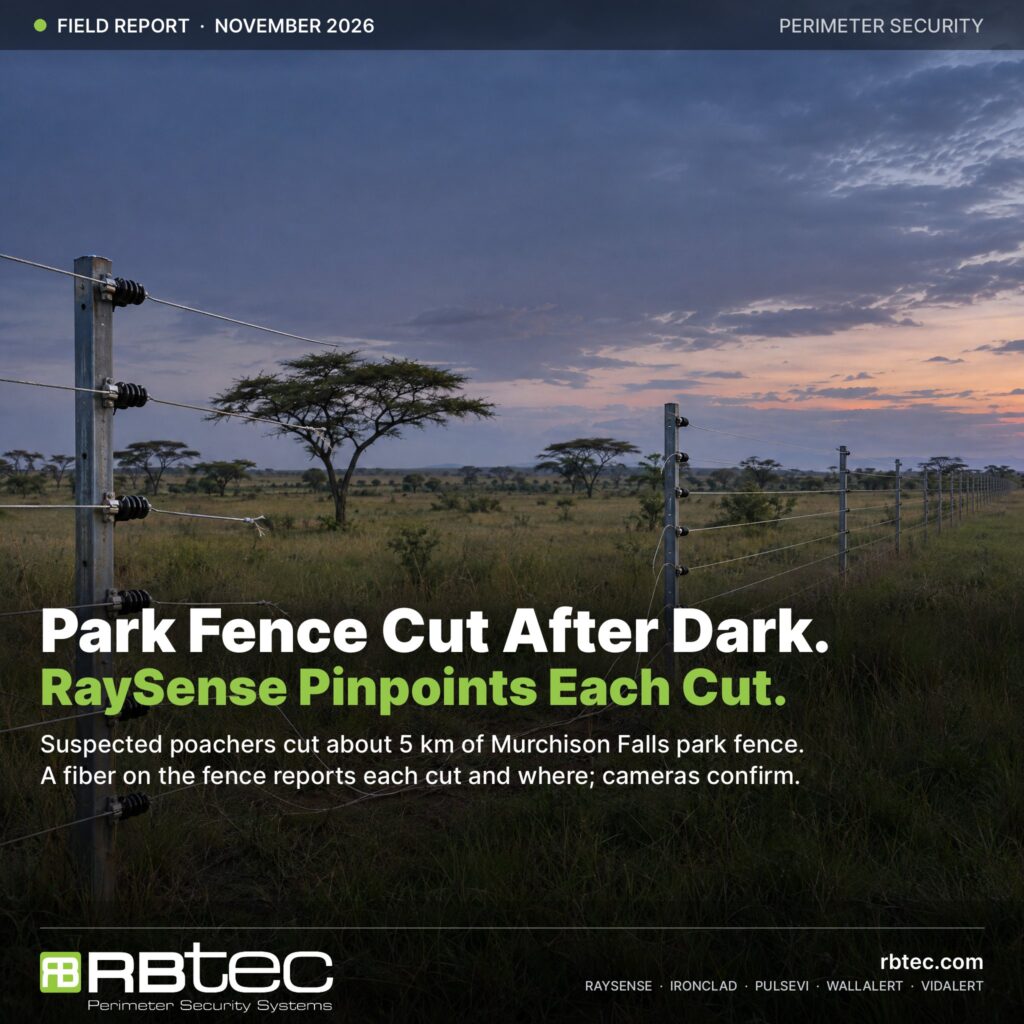
Suspected poachers have cut about 5 km of the electric fence around Murchison Falls National Park in Uganda, the Uganda Wildlife Authority (UWA) told the Daily Monitor. No one had been arrested when the story ran on Oct. 27. The authority’s bigger worry is what comes through the gaps: wild animals leaving the park for the villages next to it.
What Actually Happened
The damaged sections are in Oyam District, in the Myene and Kamdini sub-counties. Movadi Turyatemba, the park’s warden in charge of law enforcement, said the authority suspects poachers who cut the line to get into the park, possibly with help from some community members. He said the damage usually happens at night, which is why teams have to inspect the fence every day.
UWA started the fencing project in 2022 to reduce conflict between wildlife and the people who live around the park. About 126 km has gone up so far across Buliisa, Masindi, Nwoya, Oyam and Kiryandongo districts. Bonny Omara, a local parish chairman, said residents had been spared wildlife incursions so far, but that the damage could leave them exposed.
The Detection Gap
The current did not stop the cutting. People wary of it still got through, and the damage was found afterward by patrols walking the line. On a fence more than 100 km long, a daily walk means a gap can stay open for hours, and nobody knows which stretch to check first.
Cameras verify what they can see, and camera analytics can raise alerts of their own, but both depend on line of sight and lighting, and every camera in open bush needs power. Covering 126 km of fence with cameras alone is not practical. The missing piece is a sensor that runs the full length of the fence and reports where it is being cut.
How RaySense Addresses This
RaySense fence uses a fiber-optic cable mounted on the fence fabric as the sensor. The processor reads vibration along the fiber, and its AI separates someone cutting or climbing the fence from wind and rain. One processing unit handles up to 100 km of fiber with detection points 3 m apart. The fiber carries no power, so there are no field electronics or cabinets along the route, and it is not affected by electromagnetic interference or lightning-induced surges.
On the Oyam stretch, a fiber on the fence would turn each section into a monitored line. Someone cutting the wire at night makes a vibration pattern at a specific point. The alarm gives the operations room that location as the cutting starts, so a ranger team can head to the right section instead of finding the damage on the next walk. Where a camera covers that point, the operator can call it up to verify. If the fiber itself is cut, the system keeps detecting up to the point of the cut.
There are limits. RaySense detects contact with the fence, so a person standing near it without touching it will not raise an alarm. Fitting a sensing fiber to an electric wildlife fence needs a site survey, since the product page does not list electric fences specifically. Animals brushing the fence are a likely nuisance source, and sensitivity has to be tuned on site. An alarm also only helps if someone can respond, which on a large park means planning patrol coverage around the alerts.
What Facility Owners Should Ask
How do we learn today that our fence has been cut, from an alarm or from the next patrol? On our longest stretches, how many hours can a gap stay open before anyone sees it? If an alert came in tonight, could we say which section to send people to?
The Bottom Line
Murchison Falls has 126 km of fence and teams that walk it every day to find the night’s damage. A fiber on the fence can report a cut and its location while it is happening, and patrols and cameras then confirm what they find. Talk to RBtec about long perimeter fences, or read our case studies.