













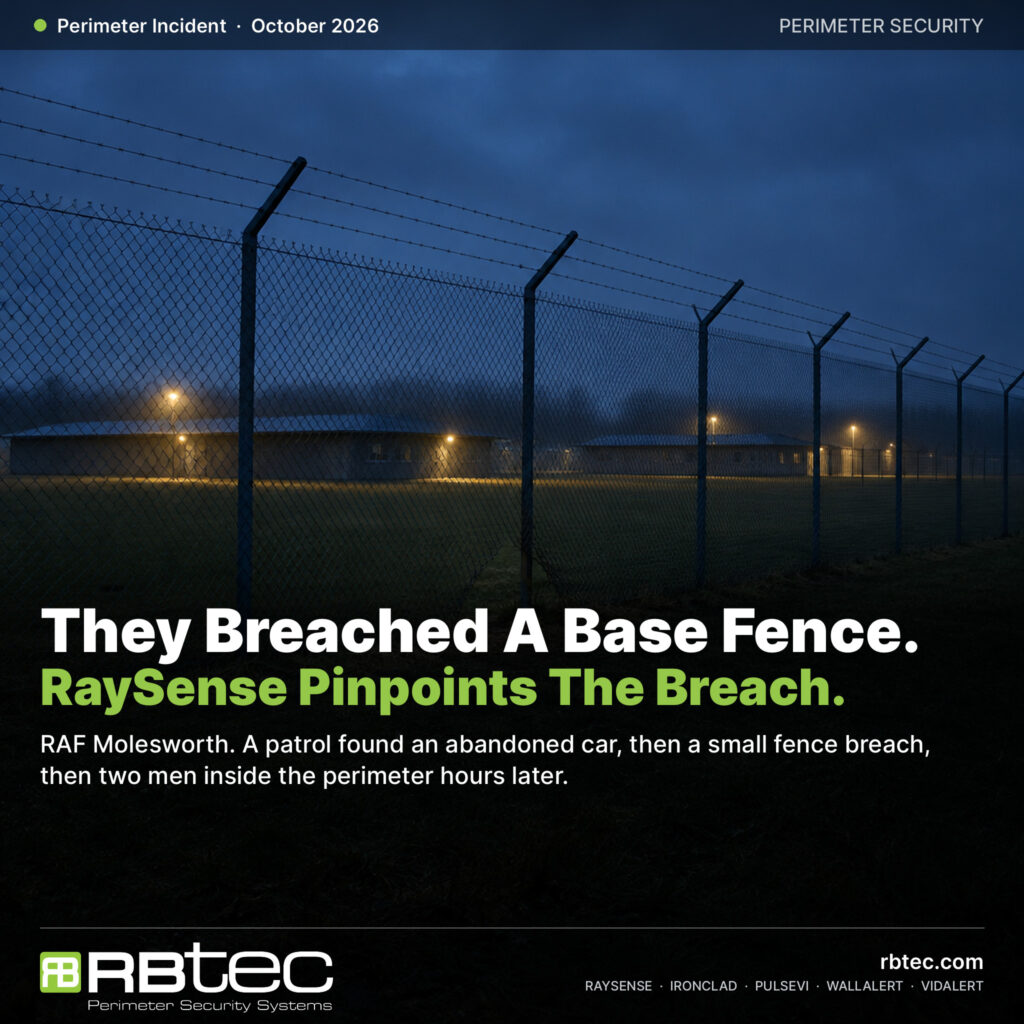
Two men were arrested inside RAF Molesworth in Cambridgeshire after a Ministry of Defence Police patrol found an abandoned car near the base and a search turned up a small breach in its perimeter fence. Counter-terrorism police are leading the investigation.
What Actually Happened
According to the BBC, which cited counter-terrorism police, an MDP security patrol at RAF Molesworth spotted an abandoned vehicle at about 10 p.m. local time on Wednesday, October 7. Officers searched the area and found a small breach in the fence. A few hours later, two men, aged 36 and 32 and living in the UK, were arrested inside the perimeter.
They were first held on suspicion of trespass on a prohibited site and criminal damage. They were later arrested on suspicion of an offense under Section 4 of the National Security Act 2023, which covers entering a prohibited place for a purpose prejudicial to the UK. Counter Terrorism Policing London is investigating and has searched two addresses in the Peterborough area. Police said they are keeping an open mind about motive and that nothing so far links the case to a separate incident at RAF Fairford.
RAF Molesworth is not a flying station. It houses US intelligence operations centers for Europe and Africa and a NATO intelligence hub.
The Detection Gap
The patrol did its job. It noticed a car that did not belong there, and that observation led to the search, the breach and the arrests. In the public account, though, the fence itself told nobody anything. The breach was found because officers went looking for it after the car caught their eye, and the two men were inside the perimeter for some time before they were found.
On a large site this is common. A fence marks the line and slows people down, and it has no way of saying when or where it was opened. Cameras are the right tool for confirming who is at the fence and what they are doing. Their view depends on placement, distance, lighting and weather, and on a perimeter several kilometers long the operator also needs to know which stretch to look at. A patrol can only be in one place at a time.
How RaySense Addresses This
RaySense is a fiber-optic sensing system. A single fiber-optic cable runs along the fence, and the processing unit reads the vibration of anyone cutting, lifting, climbing or tampering with the fabric. One unit can cover up to 100 km of cable, divided into software zones.
At a base like Molesworth, the cable would run along the full perimeter fence. As someone worked at the fabric to open that small breach, the processor would pick up the cutting or forcing pattern and report its location along the fence at the system’s 3-meter detection resolution. That point can trigger a camera call-up through the VMS, so the control room sees the spot and the patrol is sent straight to it. In this case, the alert would have come while the fence was being opened, and the patrol would have been sent to that point without first having to search for it.
RaySense separates fence attacks from wind, rain and passing traffic by looking at the pattern, strength, persistence and location of each disturbance, and it is tuned zone by zone at commissioning. It detects contact with the fence, so a person standing near the fence without touching it will not trigger it. A gate or vehicle entrance needs its own protection, and every alert still needs someone to answer it.
What Facility Owners Should Ask
If someone opened a gap in our fence tonight, how long would it take us to learn about it, and how would we know where? Which sections of the fence are out of a patrol’s and a camera’s line of sight for most of the night? When an alarm comes in, does it bring up the camera on that exact stretch? Who receives the alert, and how quickly can they reach that point?
The Bottom Line
At RAF Molesworth, an alert patrol and an abandoned car led officers to the breach. A sensor on the fence would have reported the breach and its location as it was being made, and a camera would have confirmed who was there. To review a layout for your own perimeter, contact RBtec.