














What Actually Happened
On May 29, the Coconino County Sheriff’s Office in northern Arizona received a report that several people were removing merchandise from a stopped BNSF freight train near Meteor Crater, west of Winslow, and loading it into a van and a box truck parked beside the tracks. Deputies stopped the van and arrested two men. Investigators recovered more than $500,000 in stolen goods. Two more suspects fled on foot and remain at large. Local investigators say the case is not isolated. Organized crews have been working the rail corridor across northern Arizona, hitting trains where they slow or stop in open country.
The Detection Gap
Rail cargo theft is climbing fast. The Association of American Railroads estimates roughly 65,000 cargo thefts across the network in 2024, about a 40 percent jump from the prior year, with losses topping $100 million. The reason the rail line is such a soft target comes down to geography. A single train can stretch more than a mile, and the track runs for hundreds of miles through remote terrain with no fence, no lighting, and no practical way to keep a camera on every segment.
Where cameras do exist, they depend on line of sight and on someone watching the right feed at the right moment. On open track, that line of sight is rarely there. Cameras and patrols are good at confirming what happened after a train has been opened and emptied. They are far less reliable at catching the moment a group gathers at the rail in the dark, miles from the nearest crossing. That is the gap. The loss is discovered at the next inspection, not while there is still time to send someone.
How RaySense Distributed Fiber Addresses This
Distributed fiber optic sensing was built for exactly this kind of long, unfenced asset. A single fiber run laid along the right-of-way turns the track itself into a continuous sensor. RaySense buried fiber optic detection listens along the entire length of the cable and flags footsteps, digging, and vehicles approaching the line, with software that locates the disturbance to a specific stretch of track. Instead of waiting for a camera to happen to see something, the corridor reports the activity as it starts, so a control room can verify with whatever cameras are nearby and dispatch a response.
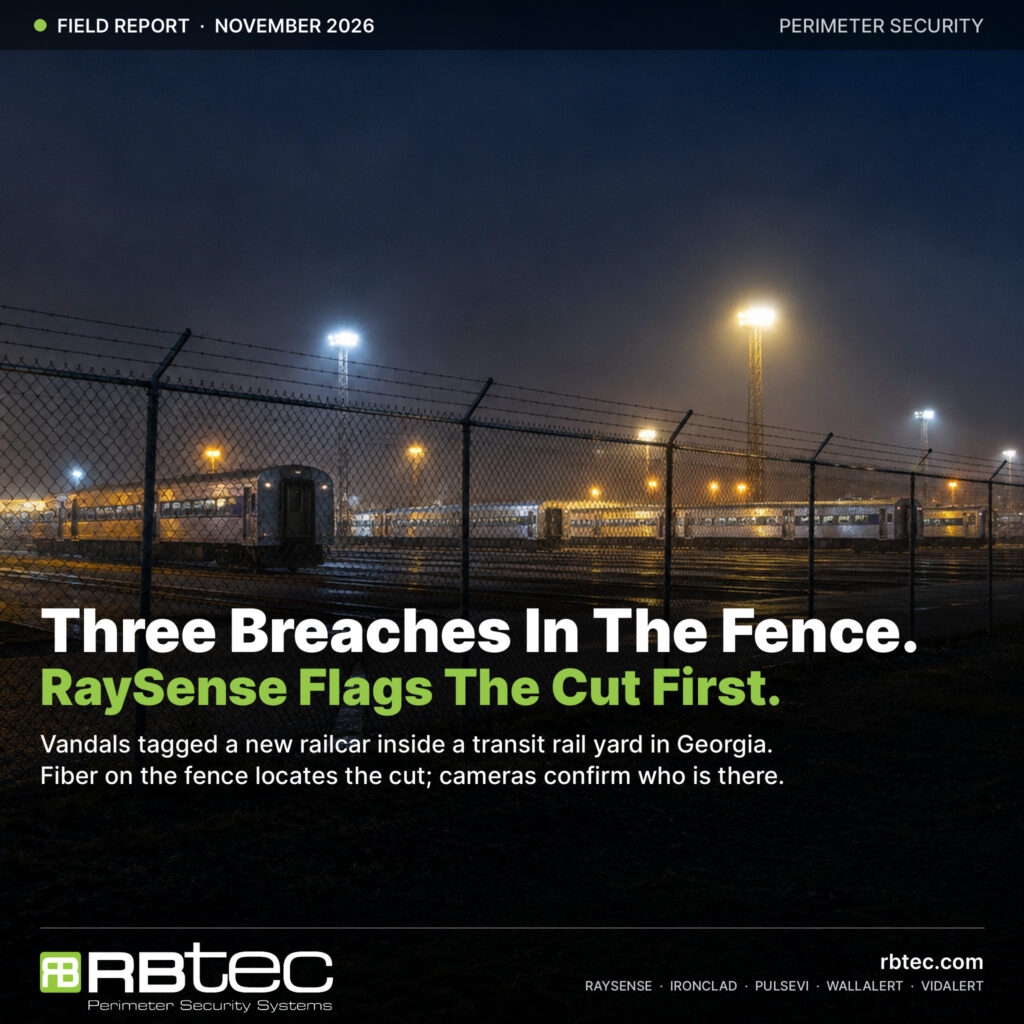
The same approach layers with fence-line detection where there is a fence to protect. At intermodal yards, sidings, and the chokepoints where trains routinely slow, IRONCLAD fence-mounted detection flags a climb or a cut at the fence line. Detection along the open corridor and detection at the fenced yard cover the two places trains are most often hit.
What Facility Owners Should Ask
Railroads, intermodal operators, and the shippers who move high-value freight can pressure-test their own coverage with a few questions. How much of our corridor has any form of detection, versus cameras alone? When an alarm comes in, can we locate it to a section of track, or only to a general area? How long is the window between an event starting and someone noticing? And do our fenced yards and sidings, where trains slow and become easy targets, have detection at the fence, or only signage and lighting?
The Bottom Line
The Arizona case ended with arrests and recovered goods, which is a better outcome than most. But it landed because deputies happened to intercept a van, not because the track told anyone the train was being worked. As organized crews keep targeting the rail network, the operators who close the detection gap will be the ones who hear about an event while the train is still on the track, not at the next audit. Cameras will always have a role in verification. The question is whether anything is listening along the line in the first place.